


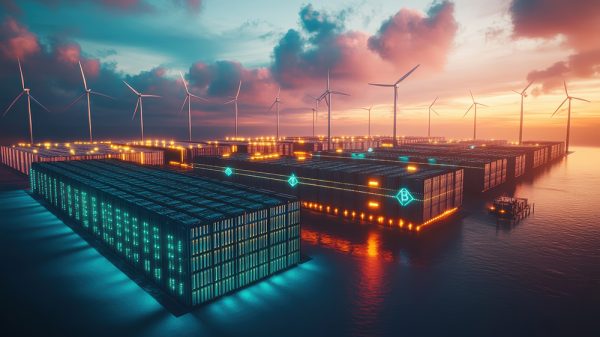
Our oceans already provide abundant energy in oil, gas and offshore renewables. But there is much more potential, with offshore data centres already in operation and offshore small modular reactors (OSMRs) gaining traction. Robert Langford, VP Global Offshore Renewables, ABS, looks at innovations driving a cleaner, smarter future.
As economies grow more digital and energy-intensive, the need for reliable baseload power has never been greater.
No single technology can meet the growing demand for electricity while providing energy security, which is why the new age of electricity is also the age of everything.
Oil and gas, renewable energy, nuclear and enhanced geothermal will all need to be marshalled, along with massive investment in battery storage and modernised grids to ensure resilient, reliable supply.
AI: turbo-charging demand
Demand is being turbo-charged by rapid adoption of artificial intelligence technologies.
The IEA, in a special report Energy and AI, projects that worldwide electricity demand from the data centres that power AI models is set to more than double by 2030 to around 945 terawatt-hours (TWh), slightly more than the entire electricity consumption of Japan today1.
And data centres are only one part of the demand picture, with electric vehicles, fully electric and battery powered vessels, offshore charging stations and home heating and cooling placing ever greater demands on electricity networks.
Across the world, advanced economies are set to see their power sectors return to growth after years of stagnating or declining demand.
Offshore disruptors to the fore
ABS believes there is now a unique opportunity for the offshore industries to play a key role in shaping the future. And not for the first time: in the 1960s and 1970s, the oil industry pioneered offshore drilling and production techniques that went on to supply the abundant oil and gas that powered record-breaking economic growth and social mobility.
Today, the offshore arena is once again poised to deliver disruptive innovation to build a sustainable, prosperous and AI-enabled future.
Floating offshore wind is one fast-emerging innovation that has the potential to make a major dent in the supply gap.
By extending beyond the shallow coastal waters used by fixed-bottom offshore turbines, floating wind turbines can be deployed in deep waters where winds are stronger and more reliable, opening up new coastal regions with large populations to renewable energy.
Indeed, according to the Global Wind Energy Council, 80 per cent of the world’s offshore wind resource potential lies in waters deeper than 60 meters and for many countries, the technical potential for floating offshore wind dwarfs that of fixed-bottom turbines2.
With a handful of floating wind farms already operational, such as Kincardine off the coast of Scotland, the world’s largest grid-connected floating wind project which ABS Classed in 2021, this is a technology that is not only proven but set to accelerate in various parts of the world in the coming years.
We are already working with clients across the offshore industries to help drive forward innovation, whether it’s R&D in new tidal and wave capacities, new rules for ship-board nuclear or certifying floating wind and offshore charging stations.
We know the world needs more of everything, and that offshore innovation will be key to delivering more in ways that are safer, more efficient and profitable.
Offshore data centres: the right solution at the right time
An innovation mindset can also help reduce the energy demands of power-hungry data centres.
By moving offshore, and using abundant unused energy from seawater, it would be possible to create a highly efficient cooling system for these computational mega-factories.
And because offshore solutions don’t bear the same land footprint issues and operate under different permitting and regulatory regimes, it’s possible offshore construction could move quicker than land-based solutions. An offshore data centre could be built relatively quickly using modular shipbuilding construction techniques or modifying existing marine assets.
It also means competitive energy procurement costs, lower utility bills due to energy-saving effects, and reduced maintenance costs by employing engineers from the shipping industry.
We have the expertise to help develop offshore data centre platforms, whether they are powered by offshore wind, solar or offshore small modular reactors, having already helped migrate other shoreside solutions offshore.
Wind turbines and solar panels, for example, have transitioned to the offshore environment, with offshore wind in particular leveraging stronger wind flows and reduced planning regulations to deliver highly competitive carbon-free energy in key geographic markets.
We know what it takes to find solutions to the unique challenges of the marine environment, whether that’s supporting the development of multiple offshore renewable technologies, working with clients on innovative tidal and wave projects, or developing the first classification requirements for the design and construction of offshore nuclear power plants.
And ABS has already shown that Information and Communication Technology (ICT) infrastructure can be deployed at sea, having worked on a cyber security project for an offshore substation in the APAC region.
The future of energy: more of everything
As we move towards a smarter, cleaner future, it is clear the world needs more of everything – both energy and computational power, The offshore environment is well-placed to deliver, whether it’s next-generation tidal solutions or seawater-cooled data centres.
References
www.iea.org/news/ai-is-set-to-drive-surging-electricity-demand-from-data-centres-while-offering-the-potential-to-transform-how-the-energy-sector-works
www.gwec.net/gwec-news/report-outlines-enormous-potential-for-floating-offshore-wind-in-energy-transition