


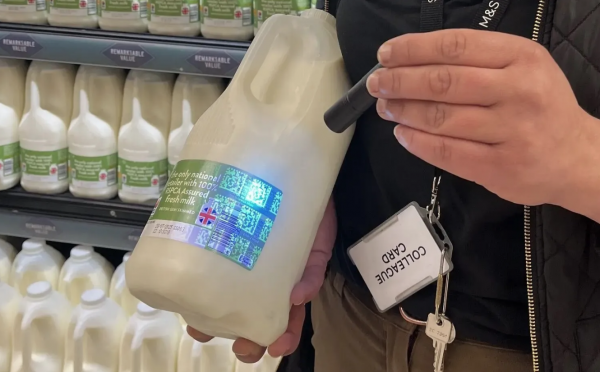
An ‘invisible’ technology might help solve one of recycling’s biggest problems – proving where plastic actually goes. Alice Rackley, CEO and founder of Polytag, explains how it works.
For decades, the recycling industry has operated on educated guesswork.
Brands put plastic packaging into the market, consumers dutifully placed it in recycling bins, and somewhere along the line, everyone assumed most of it was being properly processed.
The reality? Nobody actually knew what happened to any specific piece of packaging once it left the shelf.
That information gap is now closing, thanks to invisible UV tagging technology that’s transforming how major retailers track their plastic packaging through the recycling stream – and it’s arriving at exactly the right moment.
As Extended Producer Responsibility legislation comes into force, brands need to take responsibility for packaging materials, and that responsibility requires data, not assumptions.
From next year, brands will need to take responsibility for packaging materials as EPR requirements come into force, making them liable for the cost of recycling. Yet currently, FMCG brands have no visibility of what happens to their single-use plastic once it has been put in the bin.
Our Polytag technology works by applying invisible-to-the-eye UV tags to packaging labels during standard printing processes. Once the packaging item enters the recycling stream at a recycling centre, a Polytag UV Tag Reader identifies the UV tag, providing real-time barcode-level data, tracking through material recovery facilities.
M&S, Ocado and Waitrose lead the charge
Marks & Spencer has become the first retailer to bring invisible UV tags to shelf, applying them to labels on its four-pint milk products, available in stores across the UK.
The move represents more than just technological adoption—it’s a fundamental shift in how retailers approach packaging accountability.
M&S will fund the installation of two electronic readers at its recycling sites in Northern Ireland and Edmonton, London. These will add to existing Polytag readers across the UK.
M&S has also invested £100,000 into Polytag’s Ecotrace programme, which aims to drive the rollout of a nationwide, invisible UV tag reader network to help all businesses that tag and trace recycling through participating MRFs.
The financial incentive is clear. The data being collected will be used to inform a future response under extended producer responsibility (EPR) rules thanks to more precise reporting.
Rather than paying fees based on industry-wide recycling estimates, retailers could demonstrate actual performance, and potentially save significant sums while genuinely improving their environmental impact.
Ocado scales to full milk range
While M&S pioneered the shelf launch, Ocado Retail is applying UV tags to its own-label milk bottles, tracking them and collecting data throughout the recycling process. More significantly, Ocado Retail has announced that it is the first online retailer to extend its Polytag partnership across its full in-house milk range.
The online grocer’s approach demonstrates how quickly the technology can be deployed at scale.
The UV watermarks are not visible to consumers but are automatically detected by Plastic Detection Units (PDUs) at Material Recovery Facilities (MRFs) in the UK and Northern Ireland. This results in real-time, verified data being shared to the Polytag dashboard.
Beyond UV tags, the partnership has also now rolled out QR codes to more than 100 Ocado Retail own-label products to provide customers with recycling instructions and sustainability information. This dual approach—tracking packaging through the system while simultaneously educating consumers—represents a comprehensive strategy for closing the recycling loop.
Proven detection capabilities
Our technology’s effectiveness has been rigorously tested. During research and development, six units were installed at a plant designed specifically to test and optimise new recycling technologies in a realistic environment, achieving an unprecedented 100% detection rate. Even more impressively, the system operates effectively in real-world conditions where speed and visibility are challenging.
The scale of infrastructure deployment is significant. We believe that its MRF facilities can now monitor almost 50% of the UK’s household recycling stream. The recycling tech leader anticipates further expansion to 48 sites, which would account for 95% of household waste recycling in the UK.
Beyond compliance: strategic advantages
For businesses, the implications extend well beyond regulatory compliance. Real-time dashboards allow organisations to monitor recycling performance by SKU and location, uncovering patterns that were previously invisible.
A bottle purchased at a motorway service station might have vastly different recycling outcomes than the same product bought in a supermarket. This granular data enables targeted interventions rather than blanket assumptions about consumer behaviour.
Polytag is also partnering with advanced packaging sortation experts such as Pellenc ST, in France.
Using near infra-red signals and combining them with data in the UV tags means cleaner material streams sorted at scale. Advanced sortation opportunities can be achieved with ground-breaking partnerships, to increase the value and usability of recycled plastics – these are genuine circular economy outcomes that strengthen the proof of recycling data captured through our solutions.
The shift from assumption to evidence is fundamentally changing how brands approach packaging design and recyclability.
When you know exactly which products are failing to make it through the recycling stream, you can redesign them. When you can prove which formats work, you can scale them. And when regulators demand accountability, you have the data to support every claim.
The invisible technology making this possible isn’t revolutionary in its mechanics—it is UV ink applied during normal production runs.
What’s revolutionary is finally having visibility into a process that’s operated in darkness for far too long. For an industry facing mounting regulatory pressure and genuine environmental responsibility, that visibility isn’t just helpful—it’s essential for futureproofing operations in an EPR-driven landscape.
All Image Credits: polytag.io/products