


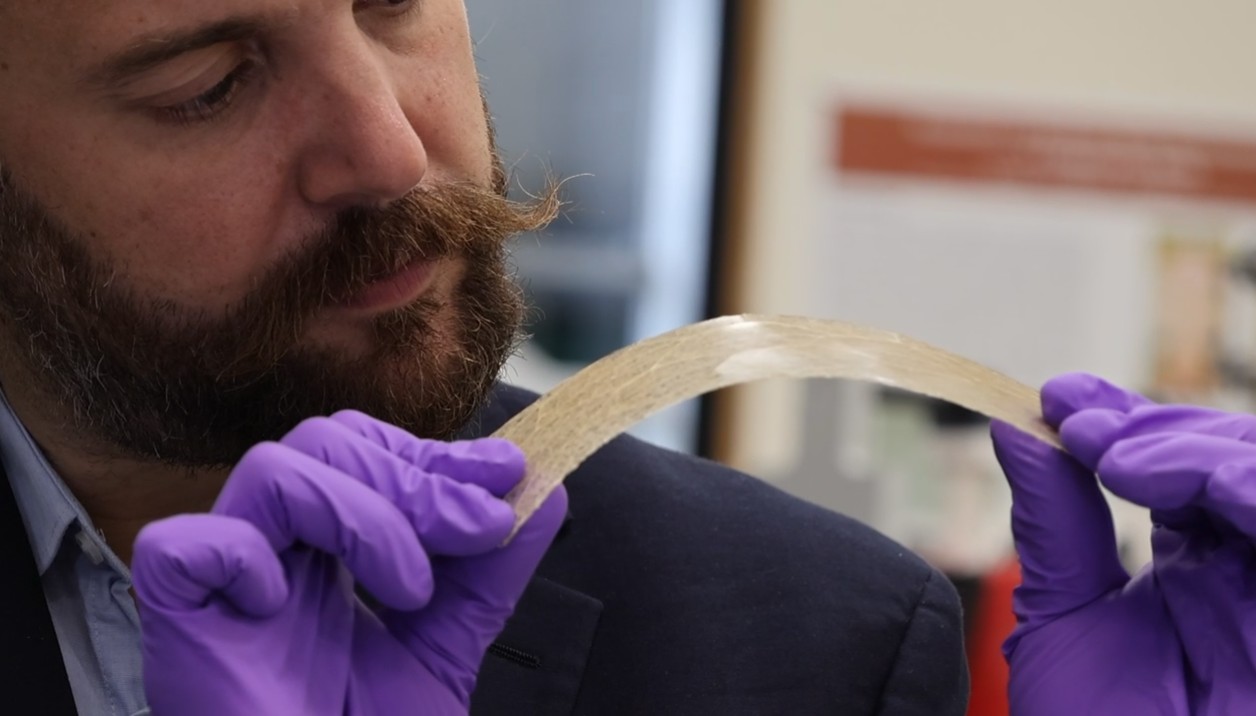
Extracting the cacti’s honeycomb network could support a new generation of low-carbon composite construction materials.
Research reveals that agricultural waste from prickly pear cactus plants could be used as a low-cost, low-carbon reinforcement for construction materials.
Composite materials combine strong reinforcing fibres with a lightweight base material, known as a ‘matrix’.
Widely used composites like carbon fibre, fibreglass or Kevlar rely on synthetic fibres and energy-intensive manufacturing processes.
Their durability also makes them difficult to reuse or recycle at the end of their lifespan.
Swapping synthetic fibres with natural alternatives offers a renewable and biodegradable solution.
Researcher Matt Hutchins led the study at the University of Bath’s Department of Mechanical Engineering.
He said: “Inside the flat cactus pads is a naturally occurring fibre network. These fibres form a honeycomb-like structure that helps the plant support its own weight and resists bending in strong winds.
“We ’re exploring how to extract these structures and keep them intact, borrowing their natural properties to reinforce bio-based composites.”
This work is the first output from an ongoing international research collaboration, led by Dr Fulvio Pinto at the University of Catania, Sicily.
A thorny issue
Plant-based fibres such as flax and hemp have been explored as natural alternatives to synthetic fibres, but their cultivation comes with environmental costs, including land use, water demand and the need for pesticides and fertilisers.
Using agricultural waste avoids these challenges and provides a low-cost, low-impact, and abundantly available alternative.
The prickly pear cactus, Opuntia ficus-indica, is a fast-growing cactus that thrives in hot, dry conditions, and its habitable environment is expected to increase as the climate changes.
Large amounts of agricultural waste are generated as a by-product of food production or from pruning to control its rapid spread in unwanted areas.
Dr Pinto said: “Although the benefits of sustainable, bio-based materials are well-known, their use in construction is still limited.
“We hope that by incorporating regionally sourced or culturally significant plants, we can not only reduce embodied carbon in building materials but also increase the adoption of natural materials in civil applications.”
Extracting the fibres
Turning cactus waste into a viable construction material relies on separating usable fibres without damaging their natural structure.
Researcher Omar Elhawary is investigating how these fibres bond with bio-based resins to create fully sustainable composites. The team compared two different methods to extract the fibres from discarded cactus pads.
The first, water retting, is a traditional technique that has been used for centuries to process flax. It involves soaking plant material in water for several weeks until the soft tissue rots away, allowing clean fibres to be removed and dried.
The second method uses changing water pressures to flush out soft plant material, cutting processing time by around 90%.
Plant waste into practical products
When mixed into plastics, the cactus fibres made materials noticeably stiffer and stronger than either component on their own, especially when bent or lightly impacted.
The resulting composites performed well at the temperatures used in low‑heat manufacturing, although they are not suitable for very high‑temperature or high‑stress applications.
While these bio‑based composites are far less strong than carbon fibre, their performance compares favourably with other plant-based materials.
Research suggests they are well-suited to lightweight, low-load uses, where low cost and environmental impact are prioritised over extreme strength.
Potential applications could include non‑load‑bearing wall panels, lightweight cladding, automotive interior components and even sports equipment such as surfboard cores.