


The Community Energy sector helps UK businesses to upgrade their premises at zero upfront cost. Dan Curtis, Brighton and Hove Energy Services Co-op, explains.
The modern business landscape is increasingly defined by volatility.
As we move through 2026, the fragility of the UK’s energy security has been laid bare once again. For many businesses, ever-increasing energy costs are becoming an existential threat.
Where a move towards sustainability may once have been ‘nice to have’, any forward-thinking business owner must now consider this essential.
A decade of volatility: Three crises in ten years
The recent escalation in Middle Eastern tensions, culminating in the closure of the Strait of Hormuz, has sent shockwaves through global oil and gas markets. This disruption serves as a stark reminder of the UK’s precarious reliance on imported fossil fuels.
This is the third major energy shock this decade, following the supply chain collapses of COVID-19 and the market upheaval caused by the Russian invasion of Ukraine.
For the UK business sector, these global shocks hit harder because, unlike residential consumers, there is no price cap for non-domestic energy bills. Energy costs already surged by 13% in July 2026, and are expected to increase again in October, leaving many firms facing a precarious Winter.
Fortifying the premises: Efficiency and electrification
To shield themselves from these external shocks, businesses must look inward at their own infrastructure. The first line of defence is demand reduction.
By investing in high-grade insulation and smart energy controls such as motion-detecting lighting and remote-controlled heating zones, businesses can significantly lower the baseline of heat and power required for their operations.
However, efficiency is only half the battle. True resilience comes from on-site generation and electrification. Some examples include:
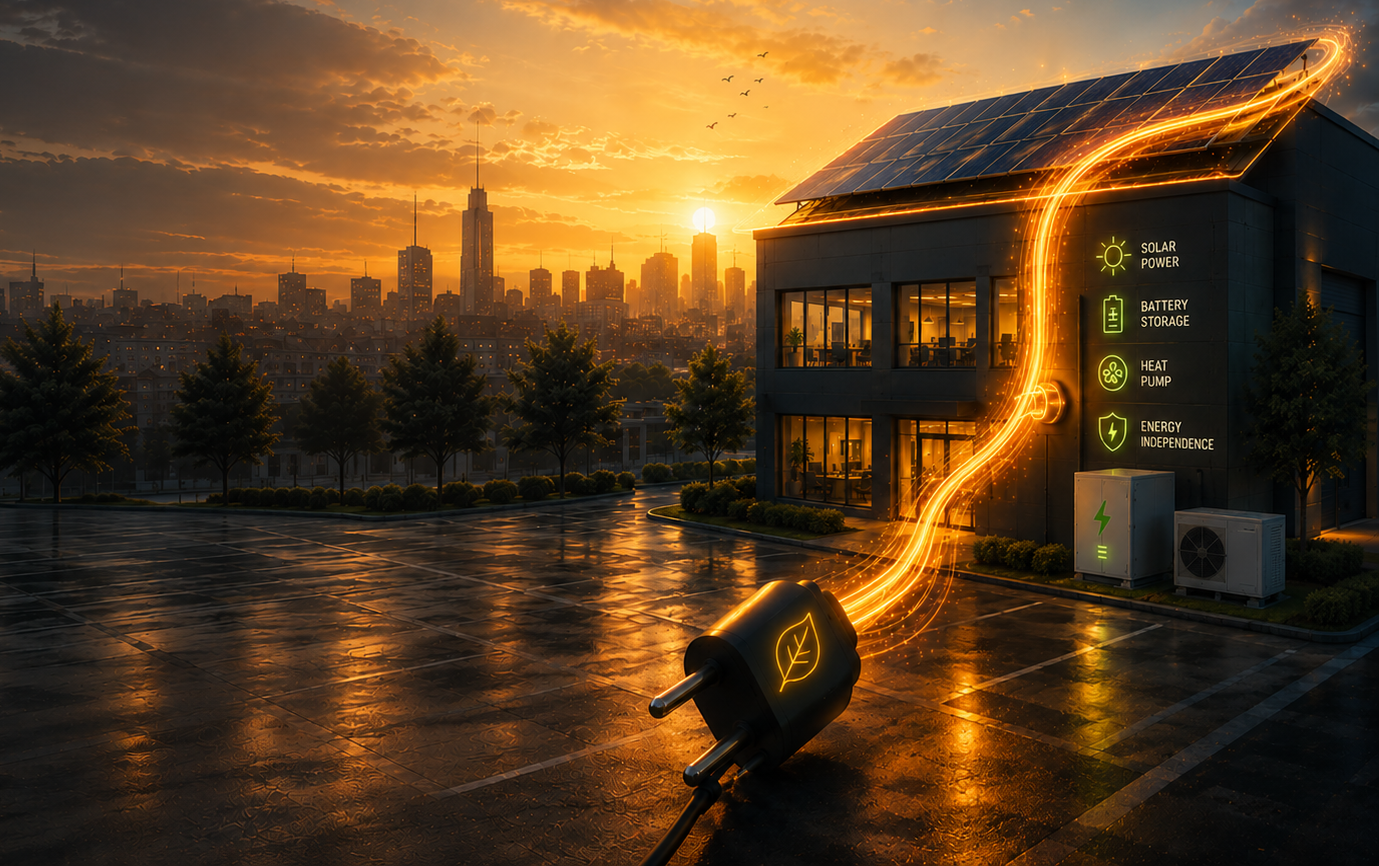
Solar PV: Converting roof space into a private power station reduces reliance on energy from the national grid and can also present an opportunity for revenue generated from export.
Heat Pumps: Moving away from gas-powered boilers to electric heat pumps removes the direct link to volatile natural gas prices. Heat pumps can be powered by on-site solar panels or batteries.
Battery Storage: Coupling solar with energy storage allows businesses to capture excess midday sun or “bank” cheap electricity from flexible time-of-use tariffs to use during peak evening rates.
Who’s paying for all this?
Despite the clear long-term savings, the timing is difficult. With more price hikes looming, many business owners are understandably hesitant to deplete their cash reserves on the significant upfront costs required for deep retrofits and renewable installations.
This is where the Community Energy sector provides a vital lifeline. Through a partnership model, businesses can upgrade their premises at zero upfront cost. Here’s how it works…
Funding: A community energy organisation raises the necessary capital via community shares or bond offers.
Installation: They manage and fund the entire installation of solar PV, heat pumps, or batteries.
The PPA: The business enters into a Power Purchase Agreement (PPA).
The PPA advantage: A PPA typically guarantees a fixed, lower cost for electricity over a 25-year period. This provides absolute price certainty, insulating the business from global geopolitics for a quarter of a century.
A golden age for community energy
The community energy model isn’t just theoretical; it is a proven engine of growth. To date, the community energy sector has secured £24 million in investment and delivered 411MW of renewable capacity across the UK.
And the scale of this movement is set to accelerate rapidly.
Following the government’s announcement of the £1 billion Local Power Plan, the infrastructure for localised affordable energy is expanding at pace.
By partnering with community energy groups, businesses can transform themselves from passive (and vulnerable) consumers into secure, stable, sustainable businesses, ensuring that when the next global crisis hits, their lights stay on and their costs stay down.