


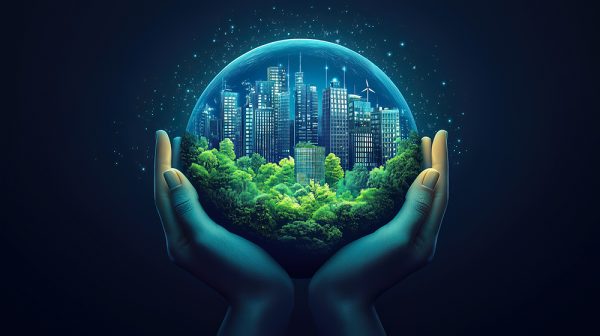
Luxury is the world’s practical R&D lab, with huge potential to develop the next world-changing ‘green’ solution, says Jonathan Cropper, founder of Futurlogic Advanced Concepts and Board Advisor to Insurgent.
Economic downturns often hit the luxury sector first, and hardest. This makes sense on the surface, given that luxury for many is deemed non-essential by definition. In most cases, we can afford to wait it out and return to luxury-level innovation when it makes economic sense.
In the case of sustainability and the health of the world we inhabit, however, there is significant time pressure. Given this, it is essential we work at finding solutions in the way that history has taught us best. And what history tells us is that oftentimes the very best innovation occurs in the luxury sector.
Luxury is where experimentation happens, free from the constraints of mass-market economics. Engineers, scientists, and designers are let loose to push the limits of what has become the technological norm. If the top of the market hits a roadblock, the entire innovation pipeline stalls with it.
It’s a model we’ve seen play out throughout history. Almost every major technological breakthrough began life as an expensive, exclusive object before gradually becoming affordable and mainstream. Take the plasma television, which sold for over $5,000 a decade ago. Today you can pick up the equivalent for a tenth of that cost.
Think back to the now-iconic ‘brick’ Motorola mobile phone, which was once a status symbol costing thousands of dollars. Now, almost everyone carries a vastly more powerful computer in their pockets. A braking system once designed exclusively for the multi-million-dollar Bugatti Veyron can be found today in an entry-level Volkswagen.
Luxury is not indulgence, or a needless avenue of expenditure for the super-rich. It’s the world’s practical R&D lab, and it’s as likely an area as any for the next world-changing sustainability solution to emerge from.
Why Innovation Trickle-Down is Vital for Sustainability
If solving the sustainability crisis were simple or straightforward, we’d surely have cracked it long ago. Instead, it’s complex and therefore expensive.
Consumers and policymakers alike wish it weren’t so, but renewable systems, circular materials, and low-carbon manufacturing, for example, require upfront investment and specialised talent. Further, it requires wealthy consumers to fork up the cost to be early, experimental adopters.
Solar power is a great example. A generation ago, solar panels were rare, expensive, and not at all associated with the rooftop of a standard semi-detached in the suburbs.
Today, however, through years of optimisation, refinement and scaling, solar power has become one of the most cost-effective forms of electricity generation available to us. The same goes for wind power; at the early stages of development, it cost eye-watering figures to install and generate real amounts of energy using wind. Now, though, as with solar, those costs have plummeted.
Electric vehicles followed a very similar pattern. Realistically, they were once viewed as high-priced novelties. However, luxury buyers, who were able to jump on board early, were key in funding the refinement and engineering that made EVs more affordable to the masses.
In the case of supercars, the uptake of electric vehicles still faces major challenges. For many car enthusiasts, there is no replacement for the growl and roar of a petrol-powered engine, something lost in comparatively quiet electric motors.
We’re now seeing the beginning of the cycle in electric vertical take-off and landing vehicles (eVTOLs). Today, the cost associated with their production and development makes it an industry that requires extreme amounts of capital. But their potential to revolutionise air travel by making it silent and zero-emission means that in a few decades, travel by eVTOLs could be as common as the electric car is becoming today.
The journey, as always, begins at the top of the market.
Materials, Manufacturing and Recycling
It isn’t only energy that benefits from luxury-standard innovation. Just as important is innovation in materials and manufacturing.
Textiles, as an example, are typically more expensive when they’re produced to be bio-friendly or recyclable. In this case, it’s not because they’re deemed luxurious versus more conventional materials, but because the systems that produce them are still maturing.
In time, those eco-friendly materials will become more affordable to produce and will inevitably filter down to mainstream fashion.
Of course, despite high-quality synthetic materials outperforming traditional materials like leather when it comes to toxicity and feel, many ‘old-school’ consumers are still locked into a mindset that heritage is supreme.
This artificially encourages them not to embrace more sustainable fashion, believing it inferior. This is something that will change as time passes and current, younger generations become the mature consumers in the market.
Even recycling, which isn’t necessarily viewed as a luxury by most, once required extreme amounts of investment to implement at scale. Initially, the infrastructure required to separate, collect and process different kinds of waste was restricted to a small number of regions. Now, it’s the norm.
Housing is the next sector waiting for the impact of high-end, sustainable innovations like 3D printing, prefabricated housing, and modular design to revolutionise the entire process. For now, these methods are niche and prohibitively costly, but soon… Well, I think you see the pattern by now.
Big Problems Require Expensive Solutions
Some global sustainability hurdles are so significant that the solutions are, by necessity, costly. Desalination is a glaring example of this. Reverse osmosis units are capable of making ocean water drinkable.
It’s a technology able to eradicate water shortages all over the world. At present, the infrastructure necessary is largely reserved for military usage, but once again, given the severity of global water shortage, it’s something that over time has to be made available at a larger scale. It is innovation at the luxury level that will do the heavy lifting in making that a reality.
For so many, the very idea of high-end or luxury industries, given the economic issues we as a world are faced with, is something to be rejected as unnecessary and indulgent. In reality, so many of the astonishing technological advancements we’ve made in the past 100 years are thanks to an industry that swallowed the initial costs to build prototypes that made mass distribution possible.
As is the case with both electric vehicles and sustainable fashion, a shift in mentality is required to speed the green transition. In both cases, romantic attachments to heritage methods and models are slowing the adoption of more sustainable options, despite the latter generally outperforming the former in most tangible metrics. An evolution towards loving a cutting-edge, glamorous eco culture is required, and quickly.
If we want to successfully accelerate the sustainable transition, it is essential that luxury’s innovation engine continues to roar. It is not a plaything of the mass affluent; it is the antidote to our planetary health.