


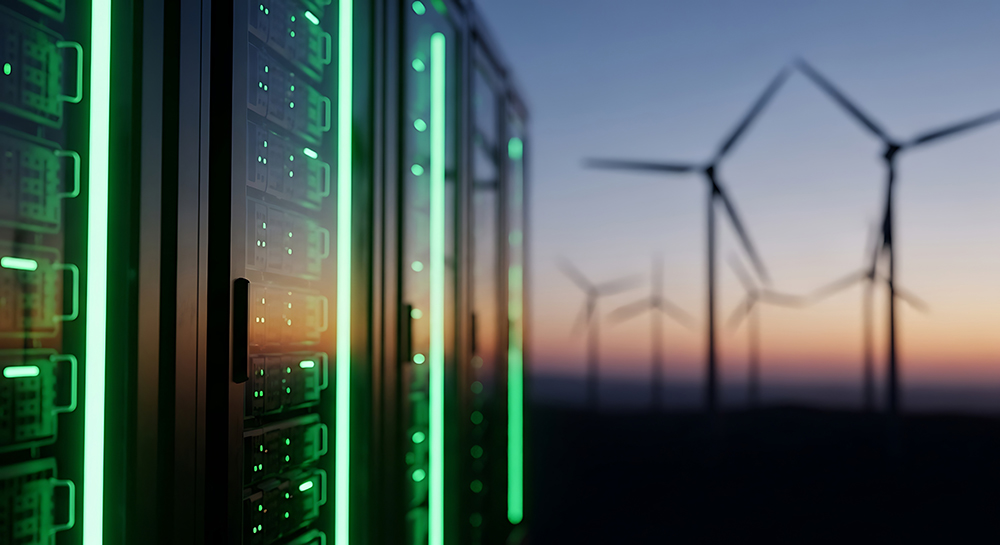
Reusing waste heat and new cooling techniques are just two of the ways that the industry is reducing its footprint, says Mehdi Paryavi, International Data Center Authority.
The AI market is expected to grow at an annual rate of 37.3% between now and 2030, tripling to $400 billion by 2030, according to the International Data Center Authority’s (IDCA) Global Digital Economy Report.
This demand for AI capacity is driving a data center boom – the physical places that store, process and run the data required to power AI. But with this comes the need for increased water consumption, energy usage and vast amounts of land, raising the question – what can we do about the environmental impact of AI and the data centers that power it? Are there ways that data centers can reduce their footprint – and even become a positive for sustainability?
Current data centers’ footprint
There’s no doubt that data centers use vast amounts of energy and water. According to the IDCA report, data centers have a total footprint of about 55GW, which is predicted to more than double to 300GW by 2030.
A recent roadmap created by Cornell University has found that by 2030, the current rate of AI growth would put 24 to 44 million metric tons of carbon dioxide into the atmosphere and drain 731 to 1,125 million cubic metres of water per year.
For comparison, this is equivalent to adding 5 to 10 million cars to US roads and is equal to the annual household water usage of 6 to 10 million Americans. At this level, the industry’s net zero targets are unattainable. However, this study pertains to older, traditional ways of building data centers.
Modern AI centers use closed-loop liquid cooling, which requires no water once the facility is operating. Furthermore, stronger data center backbones (and the world’s emerging AI backbones) make economies more efficient.
The United States, for example, produces less than half of the CO2 emissions relative to the size of its economy when compared to the world average, despite being home to the world’s largest concentration of data centers.
So, despite legitimate concerns, a deeper look reveals a more promising story – AI and data centers can indeed coexist with climate goals. In fact, they can, and will, lead the global march toward meeting them.
De-prioritising AI advancements is not the answer to climate concerns, for while consumer demand for services continues and invested economies depend on their roll out, we must instead look to solutions, harnessing AI and its associated data centers as a catalyst for good.
AI as a catalyst for good
There’s some promising research when it comes to using AI, powered by data centers, as a way to meet net zero targets and be a force for good for the environment, such as Stanford University researchers using AI analysis to spot illegal deforestation and forced labour in the Amazon rainforest.
In fact, a new LSE study has shown that AI could actually reduce carbon emissions through efficiency and automation. The authors found that if AI is applied in key impact areas, such as transforming complex systems, innovating technology discovery and resource efficiency, and modelling climate systems and policy interventions, the emissions reductions it could create “would outweigh increases from global power consumption of data centers and AI.”
When it comes to the actual data centers, they’re not simply running to serve themselves. They’re running to serve other industries – healthcare, manufacturing and so on – bringing about more efficient and less wasteful operations and building a nation’s digital economy.
For example, the US is home to 44% of the world’s data centers (calculated by IDCA research from World Bank metadata) but produces just 22% of the emissions of China and India when measured across the efficiency and productivity of their economies.
Arguably, data centers are actually improving the efficiency of nations’ overall economies, proving that societies powered by data centers can be cleaner, since they depend more on automation.
Building the right infrastructure
So if AI does have the potential to be a force for environmental good, how can data centers themselves become more sustainable?
In a meta twist, AI itself is key to minimising the environmental impact of data centers. The IDCA report has found that integrating AI into data centers’ operations has led to significant improvements in power management, cooling, security and resilience.
At the moment, there are several schemes that re-use the waste heat generated by data centers. In the US, it’s being used to heat apartment buildings. Sweden has several heat re-use projects in development, while across the border in Denmark, Microsoft’s data center is providing heat to up to 6,000 homes. Here in the UK, Milton Keynes University Hospital is one of the 74 large buildings that will be heated using excess data center heat as part of a new £95m trial by developers 1Energy.
Moving forward, the key to data centers being sustainable is getting the infrastructure right. As stated by Fengqi You, the lead academic of the Cornell roadmap: “This is the build-out moment. The AI infrastructure choices we make this decade will decide whether AI accelerates climate progress or becomes a new environmental burden.”
Choosing better locations for data centers that aren’t in water-scarce areas is a crucial consideration, according to the study by Cornell. Building data centers in areas with lower water-stress, alongside increased efficiency in cooling, means that water demands could drop by 52%. Combine these with grid and operational best practices and this could drop by 86%.
Building data centers in colder climates is another way to significantly reduce water demands, as they can avoid mechanical refrigeration for much of the year by instead using outside air, adiabatic pre-cooling and evaporative systems.
Other ways that data centers can become more sustainable includes improving server utilisation to reduce the number of servers needed and therefore the energy use required; reducing the construction size and association footprint of data centers and allowing capacity to be added as needed; and real-time optimisation and AI for power management to adjust cooling setpoints, balance workloads and reduce peak demand.
The IDCA’s report also recognises the need to develop sustainable energy to power data centers, like Nuclear and wind, rather than rely on coal-fired and natural gas facilities.
Part of the solution, not part of the problem
AI really does have exciting potential for making the world a better place.
If we all collectively demand that AI and data centers focus on the serious scientific problems found in meteorology, epidemiology, healthcare and other key areas that lead to a better understanding of how the world’s environment works, then data centers will be viewed as an integral part of the solution, rather than a problem.
Key to this is the acknowledgement that it’s no longer enough just to build the data centers of the past with the energy sources of the past.
As the world continues to build its digital economies, we need robust data center infrastructure capable of supporting AI, because the future that it can build in terms of efficiency and sustainability has innumerable exciting possibilities.
Mehdi Paryavi is the founder and CEO of the International Data Center Authority (IDCA), a leading global Digital Economy think tank.