


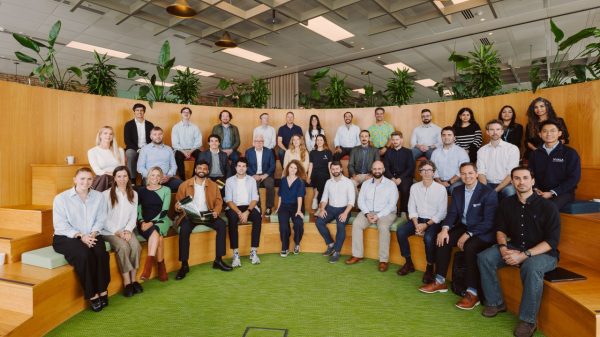
Three UK companies were selected for the 2025 Climate Tech cohort of the Amazon Sustainability Accelerator.
The initiative supports sustainable consumer product development, including climate tech, with four weeks of intensive expert-led workshops, mentoring and leadership panels.
A total of 11 companies were selected across the world, which all have a chance to pilot their technology within Amazon’s European operations.
Selected from over 550 applications, the participating companies address three crucial environmental challenges: energy efficiency, waste reduction, and water management.
Among them is Vuala, a UK-based company that uses an “artificial stomach” to break down food waste into an odourless form, before turning it into biogas and hydrogen for energy generation.
CEO and co-founder Abiel Ma said: “Traditional food waste management relies on hauling waste to centralised treatment, often has problems of odours, pests, contamination, poor recycling, and little data for improvement.
“Our data-driven ‘artificial stomach’ automatically separates food waste at source, converting it into raw material for renewable energy while driving frontline behaviour change and incentivising organisations to power a circular economy.”
The other UK innovations include Mhor Energy’s liquid flow battery, a rechargeable power reserve that can store electricity for an estimated 20 to 25 years without cooling systems, and Greyparrot‘s AI vision system, which instantly identifies more than 110 waste materials on conveyor belts to bring precision to recycling.
“Our journey began with a simple frustration over the lack of innovation in heating systems,” explains Jamie Lindsay, CEO and founder of Mhor Energy.
“This led us to develop a system that uses environmentally friendly liquids to store electricity. By creating a heat-resistant, non-flammable solution, we’re helping industries transition to renewable energy while significantly reducing their operational costs and environmental impact.”
Stand-out technologies from the wider international cohort include:
ultra-thin solar sheets that use up to 90% less material than conventional panels;
a system that transforms atmospheric moisture into drinking water without harmful chemicals;
and air conditioners that separate temperature and humidity control to slash energy consumption by up to 90%.
Amazon invested a total of £650,000 across five pilots from last year’s cohort. One 2024 pilot, with UK-based HT Materials Science (HTMS), demonstrated measurable cooling and heating energy savings across three fulfilment centres in Coventry, Daventry, and Doncaster.
HTMS’s Maxwell™ nanoparticle solution, when added to heating ventilation and air conditioning (HVAC) systems, improved their efficiency by up to 14%. Following these results, Amazon is now assessing which additional facilities in its network could benefit from implementing this technology.
The Amazon Sustainability Accelerator is supported by Founders Intelligence, part of Accenture. In total, 70 companies have been supported by the programme.
The full ClimateTech cohort of the Amazon Sustainability Accelerator are:
Mhor Energy (UK) – The team at Mhor has developed an innovative flow battery that stores energy in liquid form. It’s similar to a rechargeable battery but at a much larger scale and with an estimated lifespan of 20 to 25 years. It works efficiently even in high temperatures without needing cooling systems, making it particularly well-suited for facilities that are powered by solar energy and require a continuous energy supply.
Greyparrot (UK) – Greyparrot has developed computer vision systems that observe waste conveyor belts, identifying and categorising materials in real-time. Their AI can recognise more than 110 different types of waste, from common recyclables to complex composites.
Vuala (UK) – Vuala has developed a bio-mechanical “artificial stomach” that uses specialised microorganisms to process mixed food waste at customer locations. Their technology breaks food waste down into an odourless form that can be stored for up to a month. The processed waste then becomes raw material for biogas and hydrogen production, turning a disposal problem into a renewable energy opportunity.
Cartesian (Norway) – Norwegian technology company Cartesian has developed a thermal battery that stores heat or cold in materials that can change their physical state (like how ice can turn to water). The system stores energy when it is cheap and abundant, releasing it during peak demand hours to reduce pressure on the power grid.
Over Easy Solar (Norway) – Over Easy Solar developed a lightweight solar system that stands vertically instead of lying flat. Their prefabricated units weigh just 11 kg per square meter – about half the weight of conventional panels. This makes solar power possible for buildings that previously could not support traditional installations.
Active Surfaces (US) – The team at Active Surfaces developed ultra-thin, flexible solar sheets. These pliable sheets use a material called perovskite, which use 10 times less material than traditional solar panels while maintaining comparable efficiency. They can be installed using adhesive, reducing installation time.
Omniflow (Portugal) – Portuguese company Omniflow uses wind and solar power to create streetlights that use 90% less energy compared to conventional examples. The posts include motion sensors that automatically dim lights when no activity is detected and can support smart city applications including air quality monitoring, EV charging, and 5G connectivity.
Blue Frontier (US) – Blue Frontier’s air conditioners use a liquid desiccant technology that separately manages temperature and humidity, unlike traditional air conditioners that cool and dehumidify air in a single process. This has the potential to reduce energy consumption by up to 90% and includes built-in thermal energy storage that allows the system to run for four to six hours without drawing power from the grid.
Shayp (Belgium) – Shayp helps buildings reduce water leaks through innovative monitoring that measures ‘the pulse’ of pipelines. By connecting to existing water meters and using artificial intelligence, the system identifies issues that often go unnoticed. It has already saved more than 21 billion litres of water and typically helps buildings reduce their water consumption by up to 20%.
Solaq (Netherlands) – Using a specialized absorption process, this Dutch start-up transforms atmospheric moisture into drinking water—even in areas with low humidity. Their system, housed in standard shipping containers for easy installation, can produce up to 5,000 litres of pure water per day without using harmful chemicals.
NANDO (Italy) – NANDO transforms regular waste bins into intelligent waste monitoring stations. An app tracks small bins, sensors track large containers, and AI-powered cameras analyse waste in real-time. The system can recognise more than 70 types of waste, helping waste facility managers identify incorrect sorting and contamination immediately.