


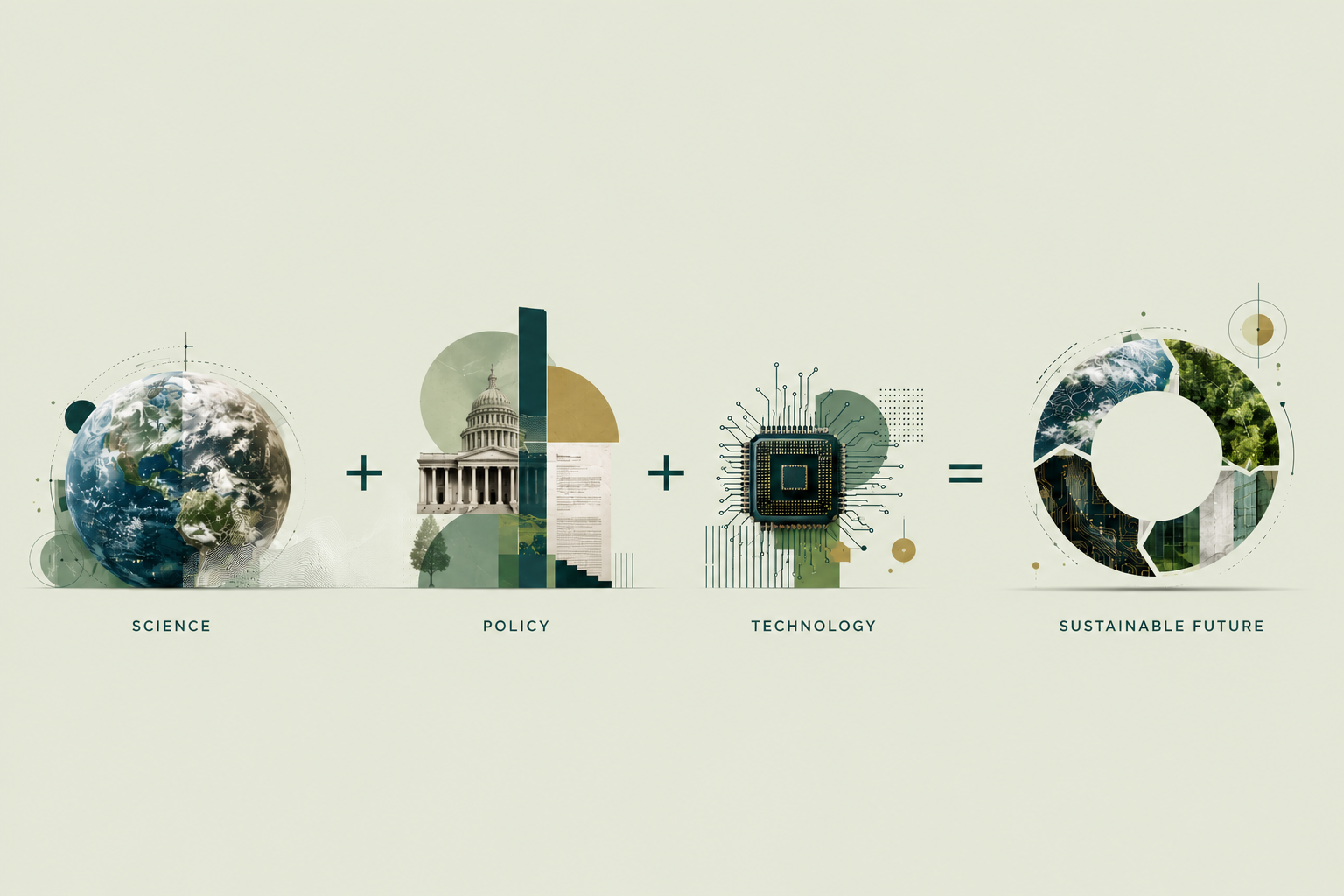
Sustainability professionals need a fundamental understanding of the science, policy, and technology surrounding climate change to do their jobs effectively, says Noelle Selin.
In recent years, governments around the globe have introduced new climate regulations, reconsidered existing commitments, and implemented significantly different approaches to energy and environmental policy.
Often, that means companies are navigating a policy environment that can look very different across markets.
That evolving policy landscape is exactly why sustainability leaders need a broader, systems-level view of climate.
Keeping up with policy developments is no longer simply a matter of tracking regulations.
Staying competitive now requires understanding how policy decisions interact with the larger climate system and sustainability ecosystem—how they influence technological development, shape market incentives, and respond to scientific realities.
Policy, in other words, is only one part of the equation. To navigate today’s climate landscape effectively, sustainability leaders increasingly need an understanding of how science, policy, and technology interact to shape both climate risks and potential solutions.
Focusing on any one of these dimensions in isolation risks creating an incomplete—or even misleading—understanding of the broader picture.
Policy
For sustainability leaders, the policy question is no longer just what the latest rule says. It is how climate policy gets made, why it varies so widely across jurisdictions, and how competing interests, market forces, and political priorities shape the direction of regulation.
Climate policy does not evolve evenly around the world.
Europe, the United States, and countries across the Global South often approach climate action from different economic and development perspectives. For companies that operate across borders, policy changes in Europe and other global markets can ripple far beyond those regions.
Even businesses that think of themselves as mainly domestic can feel the effects through supply chains, imported materials, customer expectations, investor pressure, and the demands of larger partners.
In that sense, climate policy is starting to resemble other global regulatory regimes, such as European data privacy rules, which changed how companies around the world handle information.
Climate policy also sits at the intersection of geopolitics, trade, and industrial policy, adding another layer of uncertainty for companies making long-term investment decisions.
Science
Many sustainability leaders are asked to explain climate science even if they do not come from a scientific background. In practice, that often means being the person who can respond when executives raise misleading claims or oversimplified questions.
A basic grounding in climate science provides the tools to answer those questions clearly and credibly.
It also helps to distinguish between what is settled science, where uncertainties remain, and what researchers are still working to resolve.
For example, it is true that the Earth’s climate has always experienced natural cycles of warming and cooling. But natural cycles cannot explain the speed or pattern of warming observed today. Recognising distinctions like this helps ensure that internal conversations remain grounded in scientific evidence.
New technologies and solutions often arrive with bold claims, and sustainability leaders need enough scientific grounding to ask whether a proposal is actually scalable and whether it holds up once they look past the headline.
If a technology claims to remove carbon from the atmosphere or dramatically reduce emissions, understanding the fundamentals of the carbon cycle, for example, helps them assess how meaningful that impact might actually be.
Technology
Technology is another area where sustainability professionals must navigate constant change.
New climate innovations arrive regularly with headlines suggesting that hydrogen, ammonia, fusion power, or carbon capture may dramatically reshape the future of energy.
Some of these technologies hold genuine promise. Others fade quietly after an initial wave of excitement.
Hydrogen, for example, drew significant attention across industries a few years ago, and ammonia has followed a similar arc. Neither is off the table, but the harder questions are about efficiency, scalability, and what the economic impact looks like relative to other lower-carbon alternatives.
These announcements generate real questions inside organisations. Colleagues forward articles. Executives ask whether a breakthrough changes anything. Sustainability leaders are often the ones expected to have an answer.
Answering well requires looking beyond the headline. One example is carbon offsets: identifying which actions actually contribute to net-zero goals, and which are just selling hot air, requires digging into details of the technology and how it interacts with behaviors and incentives.
Other types of technologies might have additional sustainability benefits in addition to carbon reductions – for example, electric vehicles can play a part in mitigating air quality concerns in cities.
A systems view allows sustainability leaders to ask the right questions: How scalable is this technology? What would it actually take to deploy it? What policy environment would support adoption? And what unintended consequences might emerge along the way?
Seeing the whole system
In the climate change course I teach through MIT Professional Education with Dan Cziczo, we emphasise a systems perspective. The course draws on researchers, policy experts, and industry leaders to help participants examine climate change from multiple angles and understand how those perspectives connect.
Sustainable solutions rarely come from one discipline alone. They depend on the interaction between scientific evidence, technological feasibility, policy design, economic realities, and human behavior.
For sustainability leaders, a key benefit of a systems view is that it changes the questions they ask.
Instead of asking only whether a policy applies, whether a technology works, or whether a goal sounds ambitious, they can ask how those pieces fit together, what trade-offs they create, and whether a decision will hold up as science, markets, and regulation continue to evolve.
About Noelle Selin
Noelle E. Selin is TEPCO Professor in the MIT Institute for Data, Systems and Society and Department of Earth, Atmospheric and Planetary Sciences (IDSS) and directs the MIT Center for Sustainability Science and Strategy (CS3). She also serves as lead instructor for Climate Change: Science, Solutions and Sustainability, offered through MIT Professional Education.