

Supporting green businesses to build resilient, high-performing organisations.
Green businesses are expected to grow, innovate and deliver against environmental commitments while managing regulation, cost pressure, skills shortages and rising scrutiny from customers, investors and supply chains. Sustainable performance depends on more than targets and outputs. It depends on understanding the people, teams and working conditions that make those outcomes possible, especially when organisations are asking more of their workforces with limited time, capacity and certainty.
Key takeaways
- Environmental and commercial outcomes are lagging indicators.
- Green businesses need to measure the people drivers behind delivery.
- Data should span individuals, teams, operations and leadership.
- Better insight helps leaders act before pressure affects performance.
Why this matters
For organisations in the green economy, performance is no longer measured by financial output alone. Leaders are also being judged on emissions, resource use, supply chain standards, workforce resilience, customer trust and the credibility of their sustainability commitments. These expectations are often closely connected, which means pressure in one area can quickly influence progress in another.
- Only 38% of organisations report a high level of HR data maturity.
- Only 12% of Chief People Officers and board directors use comprehensive, interactive analytics tools.
Source: Aon Human Capital Trends
Most organisations are confident in how they measure outcomes. Revenue, productivity, project milestones, energy use and operational outputs are tracked closely. Targets are clear and progress is visible. But these measures only tell part of the story. They show what has happened, not whether the organisation has the capacity, capability and confidence to keep delivering at the pace required.
As a result, businesses can find themselves reacting to performance issues after the damage has started. A delayed project, a missed target, rising absence, a safety concern or a loss of key talent may appear sudden. In reality, the underlying pressure has often been building for some time, showing up first in smaller signals such as stretched managers, slower decisions, reduced energy or teams struggling to absorb change.
The gap between outcomes and drivers
Sustainable performance does not happen in isolation. It is shaped by a combination of factors:
- How individuals feel, work and recover.
- How teams collaborate, make decisions and manage pressure.
- How work is structured, led and supported.
For green-sector employers, those factors matter because delivery pressure is increasing. Net zero transition, evolving reporting expectations, green skills gaps, supply chain scrutiny and energy cost volatility all raise the bar. Yet many of the things that determine whether organisations can respond effectively are still measured too lightly, if at all. This makes it harder to understand where performance is being supported by healthy capacity, and where it is being maintained through short-term effort that may not be sustainable.
This creates a gap between performance outcomes and performance drivers.
An organisation may know that a programme is behind schedule, but not whether the issue is caused by workload, unclear ownership, capability gaps, low engagement or competing priorities. It may know that productivity has fallen, but not whether people have the right support, tools and leadership to sustain performance. Without that insight, leaders can end up treating symptoms rather than addressing the conditions that created them.
Moving from reactive to proactive
Instead of focusing only on outputs, organisations need to understand the conditions that enable delivery. This is especially important for businesses operating in fast-moving, resource-conscious and regulation-heavy markets, where small pressures can build quickly and where the cost of delayed action can be significant.
That means looking beyond traditional metrics and considering:
- Individual-level factors such as wellbeing, energy, financial confidence, fatigue and skills readiness.
- Team-level dynamics such as alignment, trust, collaboration and decision-making under pressure.
- Organisational factors such as leadership consistency, workload design, culture, capability planning and change readiness.
- When these elements are measured together, leaders get a more practical view of performance. They can see where pressure is building, where teams need support and where business ambition is outpacing workforce capacity, before those pressures begin to affect customers, projects or people.
What better measurement enables
With the right data, organisations can move from reactive to proactive performance management. They can make decisions earlier, with better context, and avoid relying only on end-point measures that may arrive too late to influence outcomes.
- They can identify whether operational teams are carrying unsustainable pressure before it affects safety, service or delivery.
- They can understand whether managers have the tools and confidence to lead people through transition.
- They can see whether capability gaps could slow progress against sustainability, transformation or growth plans.
This allows performance to be shaped, rather than simply observed. It also helps leaders focus their attention where it will have the greatest effect, whether that means strengthening manager capability, adjusting workload, improving communication or investing in the skills needed for future delivery.
The role of integrated frameworks
Frameworks such as Aon’s Human Sustainability Index bring these elements together.
By measuring performance across individuals, teams and the organisation, they provide a more complete view of how performance is created and sustained. For green businesses, this can help connect workforce insight with broader business priorities, including resilience, productivity, safe delivery, innovation and credible sustainability progress. It gives leaders a clearer line of sight between what the business wants to achieve and whether the organisation is set up to achieve it consistently.
This shifts the conversation from outputs to conditions; from what performance looks like, to what enables it.
Measurement as a leadership tool
Better measurement is not just about data. It is about decision-making.
It gives leaders the ability to:
- Prioritise people, investment and management attention more effectively.
- Allocate resources where pressure, risk or opportunity is greatest.
- Intervene early before issues affect service, safety or delivery.
- Design performance more deliberately, rather than relying on short-term effort.
In environments where pressure is constant, this becomes a significant advantage. It also supports credibility. If organisations are making external commitments on sustainability, transition or social value, they need confidence that the internal conditions exist to deliver them. That confidence comes from understanding not only whether progress is being made, but whether it’s being made in a repeatable, sustainable way.
Final thought
Performance cannot be sustained if it is not defined by the organisation and understood by its people. And it cannot be understood if it is only measured at the point of outcome.
For green businesses, the next advantage will come from measuring more than environmental and commercial results. It will come from measuring the human conditions that make those results possible: resilient people, aligned teams, capable leaders and work designed to sustain performance over time. That is how organisations can protect delivery today while building the confidence, adaptability and resilience needed for future growth.
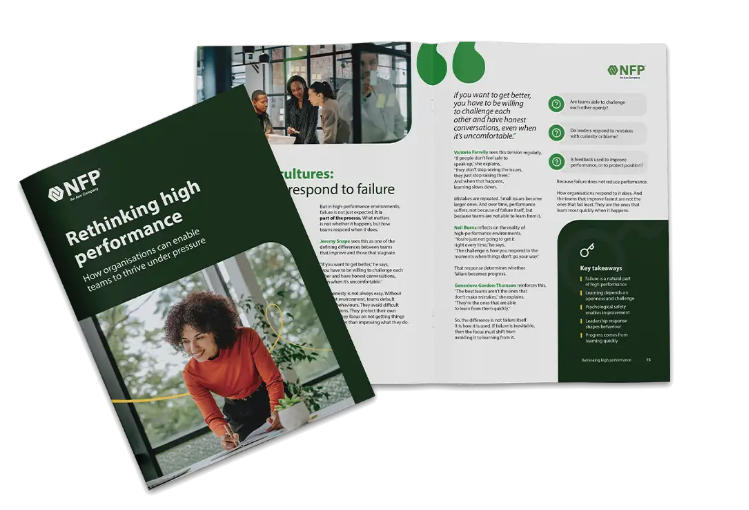
Want to understand how to design sustainable high performance?
Download our report here.
Most organisations today are operating under sustained pressure. Expectations continue to rise, resources are constrained, and the pace of change continues to accelerate.
Featuring interviews with leading figures across sport, law, psychology and business, this report shows how to build a high-performance culture that helps leaders, teams and organisations thrive sustainably.