


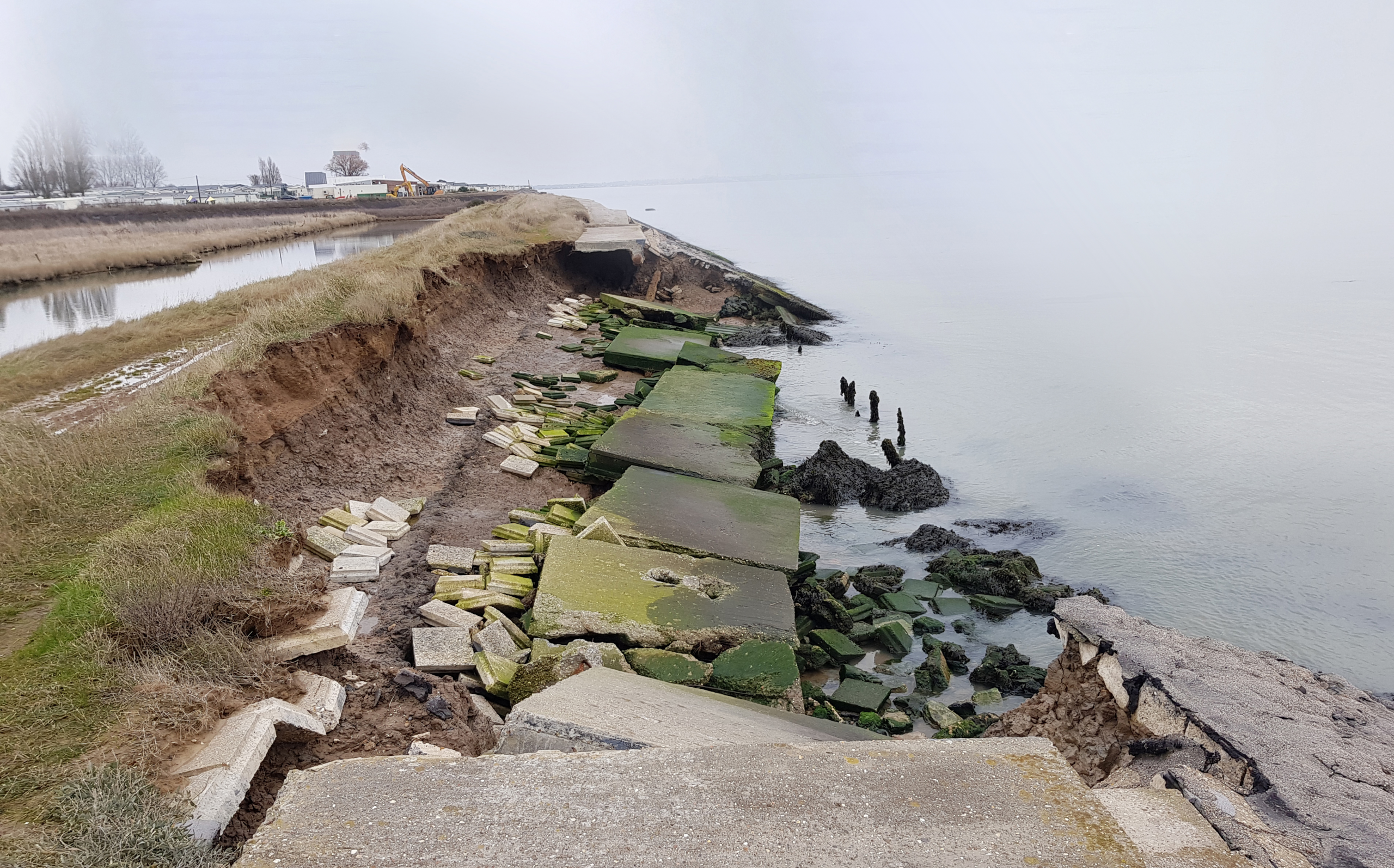
Rising water levels and more powerful, frequent storms are driving greater erosion in the UK. Roger Smith, managing director of Hesselberg Erosion Protection, explains how early intervention with new approaches and technologies can help.
Across much of the UK, coastal erosion is treated as an environmental issue rather than an economic one.
It tends to make headlines when a house collapses into the sea, or a stretch of cliff gives way after a storm. But for businesses, infrastructure owners and local authorities, erosion is becoming a far broader challenge, affecting transport routes, ports, utilities, tourism, and long-term investment planning.
As the UK’s weather patterns change, and the intensity and frequency of storms continue increasing, the pace of coastal erosion is picking up. In many areas around our coasts the threat is pressing, and the costs for both mitigation and remediation are rising.
How much land has the UK lost?
People often ask for a single national figure on land loss. The reality is that coastlines are constantly shifting. Some areas retreat, while others build up as sand and sediment move along the shore. What we do know is that the UK has lost a significant proportion of its natural coastal defences over recent decades. The Climate Change Committee has reported that around 13,000 hectares of saltmarsh, sand dunes and shingle habitat have disappeared since the mid-1940s – roughly one fifth of what once existed.
These habitats are not just areas for wildlife. They act as natural buffers that absorb wave energy, and reduce erosion and flooding further inland. When they are lost, the land and communities behind them become more exposed, including roads, businesses and critical infrastructure.
Is coastal erosion really speeding up?
In many places, yes. Long-term monitoring shows that more coastline is now retreating, in some areas faster than it did in the past. The Met Office has made clear that sea level rise is the primary driver of future coastal flood and erosion risk in the UK. Higher seas lift the starting point for every tide and storm surge, allowing waves to reach higher up beaches and cliffs, and do so more often. Over time, that extra reach translates into faster wear and retreat.
Erosion is not accelerating everywhere, however – local geology still plays a huge role. Hard rocky coastlines behave very differently from soft clay cliffs or sandy shores. Areas of the south coast, for example, are particularly prone to erosion by virtue of their underlying geology. On the other hand, large sections of northern and western coasts are very resilient. Still, overall, rising seas are tipping the balance in the wrong direction.
What is the cost to the economy?
The cost of erosion is often wrapped up with flood damage, which makes it difficult to separate neatly. The British Geological Survey calculates that approximately 1,000 miles of major roads, 400 miles of railway line, 92 railway stations and 55 historic landfill sites are at risk of coastal flooding or erosion by 2100. The Climate Change Committee estimates that direct economic damages from coastal flooding and erosion already exceed £260 million a year. That doesn’t fully capture lost productivity, transport disruption, supply chain impacts, or the long-term effect on local economies.
The scale of investment needed to manage these risks is also significant. The Environment Agency has projected that around £1 billion a year will be required over coming decades to manage flooding and coastal change effectively.
There is also the cost of repeated emergency repairs. Each storm that undermines a quay wall, embankment or access road brings callouts, temporary works, lost operating time and rising maintenance budgets. For many asset owners, this cycle of disruption is already becoming the norm. Spending on erosion and flood management therefore delivers strong returns, by preventing much larger losses.
Can erosion be stopped or slowed with new technology?
In some areas, erosion can be slowed very effectively, but in others it’s technically difficult and increasingly expensive. However, recent years have brought new approaches, and innovative materials. Drones, satellite data, repeat surveys and improved modelling now allow engineers to track shoreline movement, cliff stability and seabed changes in detail. This means intervention can happen earlier, which is almost always more effective and cost-efficient.
Traditional methods such as concrete sea walls are highly protective against erosion and strong wave action, but they’re expensive, and their production and transportation have a high carbon footprint. Alternative technologies such as open stone asphalt (OSA) and lean sand asphalt increase stability, are flexible to cope with settlement, and can be employed with a much lower carbon footprint. On a recent £75 million, two-mile (3km) shoreline defence project at Canvey Island, Essex, a rock solution was calculated to account for over 50% more carbon than the chosen asphaltic solution.
Hard structures such as rock revetments still play a vital role in protecting key infrastructure, but the most resilient modern schemes often combine these with nature-based measures such as beach nourishment and saltmarsh creation. When designed properly, these reduce erosion pressure while improving biodiversity and lowering maintenance requirements.
Private and public enterprises are under increasing pressure to balance effectiveness and economic cost with carbon cost. Solutions that can support and promote biodiversity are appealing, especially if they can last twice as long as a structure that would need frequent repair and rebuilding.
The uncomfortable truth
The uncomfortable truth is that natural forces and the compounding effect of a changing climate mean the UK can’t hold every metre of its coastline in place forever. Rising seas will continue to increase pressure on natural and engineered defences and strong decisions will be required. But new technologies and approaches can help manage the pressure on our coastlines and waterways. The key is acting early: left until crisis point, protection and prevention become vastly more expensive and challenging.