


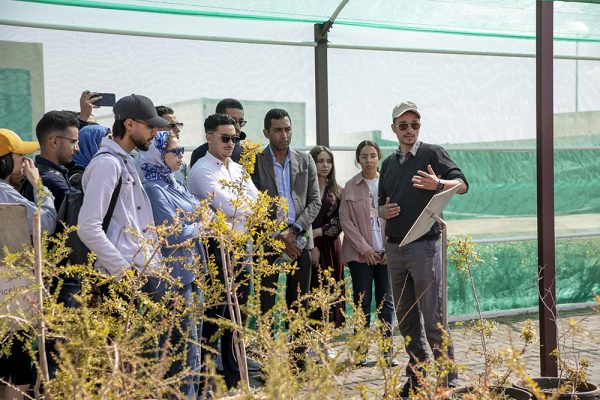
Smart farming tools pioneered by African start-ups – combined with UK strengths in AI and data – could transform the farming landscape. Yassine Laghzioui, Chief Entrepreneurship and Venturing Officer at University Mohammed VI Polytechnic (UM6P), and CEO of UM6P Ventures, explains all.
Agriculture is entering a critical turning point, where feeding the world must also go hand in hand with restoring ecosystems and successfully adapting to climate pressures.
In the UK, agriculture is responsible for roughly 12% of national greenhouse gas emissions, and recent seasons of extreme rainfall and heat stress have intensified the vulnerability of domestic supply chains.
But this isn’t just a UK-specific issue. Water scarcity and erratic weather patterns are affecting production systems worldwide.
African agriculture faces even sharper constraints, including frequent droughts and rising temperatures. Africa’s response to these conditions has produced solutions that offer lessons for the rest of the world: innovations designed to work under scarcity, uncertainty and complex social and ecological constraints.
Climate-smart farming
The agricultural sector accounts for around 30% of Africa’s GDP and provides livelihoods for over 50% of the population, yet its extreme vulnerability to climate risks poses a major challenge.
For instance, between 2000 and 2022, droughts and floods in the Sahel and Horn of Africa regions contributed to 12,000 deaths and cost $11.5 billion in crops and livestock losses.
Against this stark backdrop, climate-smart solutions are survival strategies. And within this, systems that blend scientific insight with local environmental knowledge have taken precedence over high-input farming models.
Sand to Green demonstrates how this integration works in practice. By turning degraded or desertifying land into productive zones through soil analysis, biodiversity planning and precision irrigation, the company shows how regenerative methods can operate even where starting conditions are extremely poor.
This is particularly relevant to the UK at a time when soil carbon loss and biodiversity decline are becoming central policy concerns.
Indeed, technology-led farming is increasingly becoming a cornerstone of biodiversity efforts. Innovations like robotic harvesters and AI habitat mapping are helping farmers protect biodiversity while also boosting productivity.
Robotic systems can reduce soil compaction and optimise harvest timing, improving yields while also reducing ecological disturbances.
Meanwhile, AI-driven habitat mapping enables farmers to identify and protect biodiversity hotspots within their land, making it far easier for farmers to integrate conservation into everyday operations.
These technologies show that farming can become a driver of biodiversity restoration, turning conservation into an integral part of agricultural practices.
Ground-level solutions
The UK can also learn a great deal from Africa’s ability to integrate local challenges into technology design. Across the continent, the most durable agritech solutions have emerged from close engagement with farmer realities rather than controlled laboratory settings. Cinch and Ground Truth Analytics showcase this field-driven approach.
Cinch, which operates in farms across Kenya, has developed a model that brings unused or under-utilised land into productive circulation.
This approach gives landowners guaranteed income and provides produce buyers with access to year-round supply. By combining agronomy expertise, rapid farm deployment and per-acre traceability, Cinch shows how scalable, tech-enabled production systems can thrive even under volatile weather patterns and infrastructure gaps. These conditions are becoming particularly relevant to UK farmers who increasingly face unpredictable seasons.
In the same vein, Ground Truth Analytics blends data from satellites, ground sensors and models to produce accurate views of key features such as soil moisture and crop stress. As UK farms grapple with erratic rainfall patterns and new requirements for soil health monitoring, these forms of high-resolution, adaptive diagnostics offer a valuable reference point.
Adaptation over replication
While UK farmers face milder constraints than their African counterparts, the pressures are no less urgent: reducing emissions, improving resilience to unpredictable weather and maintaining productivity under rising costs. Africa offers valuable lessons here. Climate-smart technologies tested under scarcity reveal principles that could accelerate decarbonisation and resilience in the UK.
Importantly, this exchange of ideas should be mutual. African ventures can draw on UK expertise, particularly in areas such as AI-based crop monitoring, genomic research and vertical farming infrastructure. Together, these strengths create a two-way knowledge exchange that supports global progress, where the goal is not replication, but adaptation.
Resilience through real-world limits
Innovation that grows from friction endures. Unlike solutions developed in resource-abundant environments, African agritech ventures are forced from day one to prioritise frugality and rapid adaptability.
They cannot rely on perfect infrastructure, deep-pocketed subsidies or stable climates. Having to contend with real-world limitations creates business models and technologies that are not just efficient, but resilient. These systems are designed to thrive in volatility, making them uniquely suited for a global future defined by climate disruption and instability.
The scalability of these solutions relies on successful adaptation. An effective model in Kenya’s arid lands cannot be copied and pasted to Zambia’s savannas, let alone to a UK farm. Technology is a key driver here.
By combining African principles of frugality and resilience with UK strengths in AI and data, we can create new agricultural practices for the modern economy. What matters now is building farming models that align with our natural systems. That’s the only way they will endure over time.